Monday, 3 January 2011

Premier League clubs await LA decision on David Beckham


Tottenham are among several Premier League clubs waiting to hear whether Los Angeles Galaxy will release David Beckham this month for a loan deal.
Manager Harry Redknapp says the 35-year-old is keen to join Spurs, while Newcastle and Blackburn are interested.
The Major League Soccer season resumes on 15 March, meaning Beckham could play up to 11 games in a short-term deal.
"Spurs are one of many clubs interested - but we have not yet had detailed talks," said a spokesman for Beckham.
"At the moment we are waiting on the decision of LA Galaxy with regards to a loan move. The loan would be a short one until the start of the MLS season.
"David would then return and play a full season with the Galaxy.
"The loan is part of David's desire to keep fit and make himself available for England again."
Former England captain Beckham had short-team spells on loan at Italian club AC Milan in 2009 and 2010, with the moves designed to improve his chances of being picked to play for his country.
And England manager Fabio Capello, who last fielded Beckham in the 3-0 win over Belarus in October 2009, has recently urged the midfielder to return to Europe to prove his fitness.
With the January transfer window now open, Blackburn boss Steve Kean said on Monday that Rovers would be interested in Beckham while Newcastle boss Alan Pardew indicated the same on Sunday, though he has since admitted the move is unlikely.
Redknapp revealed he first learnt of Beckham's interest via his son Jamie, a former Liverpool and Tottenham midfielder.
"He [Beckham] spoke to Jamie, that's how it all came about," said Redknapp senior. "He said 'I'd like to come back and I fancy playing for Spurs because I like the way they play'.
"I've left it to the people at the club and they're talking to whoever they have to talk to at his club.
"David fancies it. He's a fantastic lad and role model in the way he conducts himself and plays. He'd be a great influence on the younger players."
A move to Spurs would mean Beckham could face his first club - Manchester United - at White Hart Lane on 16 January while he could also line up against another former club, AC Milan, who play Tottenham home and away in the Champions League last 16.
Those fixtures all come before the LA Galaxy's first match of the MLS season against Seattle Sounders.
Chairman of Tottenham Supporters' Trust Bernie Kingsley told BBC Sport on Monday that he felt it would be "dreadful" if Beckham moved to White Hart Lane, while stressing this was his own personal opinion and not representative.
"He's one of the most over-rated players in the game for a long time," said Kingsley. "He's a circus and totally about David Beckham - not [the club] who he plays for. I just don't want to see him anywhere near Tottenham.
"We have a good team and we're having a good season. If we want to continue with a squad of players that are fighting for each other, they don't need the distraction of some prima donna player who is only interested in himself.
"Yes, he's a good crosser of the ball - but his time was years ago. He's let England down in big tournaments. A football team is about 11 men on the pitch, playing as a team. I don't think he's a team player."
Former Real Madrid midfielder Beckham was born and raised in London, and trained at Tottenham before signing his first professional deal with Manchester United.
The six-time Premier League champion has not has previously been tempted by offers of a return to England, turning down the chance to discuss a similar deal with Everton in November while stating that, as a Manchester United fan, such a move was "too close to home".
He also denied any interest in a move to West Ham in July and rejected the chance to be reunited with former England boss Sven-Goran Eriksson at Leicester in December.
But Beckham recently told BBC Sport there was an outside chance of appearing for a different English club to United, and that he hoped to continue playing for two or three more years.
"I want to continue to play, I have no interest in stopping," he said. "It might surprise people [now I am 35] but I'm still loving the game and still enjoying it as much as when I was 25.
"I played in the Premiership for so many years with the club I always adored, and will always adore. I always said that I would never play for another English club in the future - but you never know.
"I would hope I carry on playing for another two or three years. I've got a year left in America and then possibly another two after that. My body feels good at the moment."
Redknapp believes that it might be the right time for both Beckham and Spurs, who sit five points behind Premier League leaders Manchester United in fourth place.
"I'm sure he can still do a great job at the top level, otherwise I wouldn't bother," he said on Friday.
"He isn't going to come here and get big money - we aren't massive payers at this club. But he wants to come over here to the freezing cold and play football.
"Doesn't that tell you something about the boy that he lives in Los Angeles and might be a billionaire?"
Blackburn manager Kean, recently appointed until the end of the season following the shock sacking of Sam Allardyce, would like Beckham to be among the new faces he hopes to bring to Ewood Park during the January transfer window.
"I think we will sign at least three, possibly four, we might have one on loan at least at this stage that is the way it is looking," he said.
"Hopefully talks can continue and with someone like Beckham, someone will get a good player if he comes over here. If he does come back to this country, he is someone we would be interested in."
Newcastle boss Pardew said on Monday: "People are suggesting we are in the market for him because I've said I want an offensive player and obviously, he is one of the few on the market.
"I have not dismissed it, but in no way are we in talks or anything like that. It is unlikely, but we have targets elsewhere which give probably more chance of fruition than that one."

Wednesday, 15 December 2010

The 1961 Presidential elections of the Somali Republic: A test of Democracy

On July 1st 1960, The United Nations Trust Territory of Somaliland under Italian Administration and the British Protectorate of Somaliland joined to form a new nation called the Somali Republic. On that day the only biding element of the two territories was a “brotherly love of two Somali lands separated by European powers” without regard for the peoples concerned; and a document known as the Act of Union. The act was not a charter or a constitution defining the form and type of Government. It was simply a list of declarations uniting the institutions of the two territories, such as the armed forces, the civil services, etc.

The most important action was the unification of the Legislative Assembly (south) with 90 members; and the Legislative council (North) with 33 members into a unicameral National Assembly with a total of 123 deputies. At the time, the joy of having a united independent Somali nation was bigger than anything else. Everything else was shelved for future considerations. That included the ratification of the country’s constitution.

The first business of the National Assembly was to “select” a Provisional President of the new Republic. The deputies unanimously agreed the Speaker of the Parliament, fifty-two year old deputy from Belet-weyn, Honourable Aden Abdullah Osman popularly known as Adan Cadde, to lead the nation for one year. Adan Cadde was a veteran politician and an early member of the Somali Youth League - the majority party in the National Assembly.

Under a year later, the new constitution was completed by a Somali committee with the help of UN experts. A date was set on June 20, 1961 to put the constitution on a referendum throughout the country. An absolute majority of 1,952,662 or over 90 percent of the electors voted in favour of the new constitution. The referendum had another important significance: It exposed the long-held doubt of the colonial population census of the Somali people estimated at only 2.5 million.

The Somali Republic’s constitution is modelled on the Italian pattern of Parliamentary Democracy, which gives central role to the Prime Minister. According to article 1 of the new constitution, the Somali Republic is a “representative, democratic, and unitary state … indivisible” for which the Islamic sharia is the main source of the laws. Under the Parliamentary system, the government is headed by the Prime Minister and the Council of Ministers, subject to the confidence of the parliament.

As a republic, Somalia has an elected President as Head of State. In article 75 of the constitution, symbolic power is vested in the President of the Republic, who is elected by the National Assembly for a six-year term. He is the commander-in-chief of the armed forces and authorizes “the presentation to the Legislative Assembly of bills originated by the Government.” The President’s most important task is to select the Prime Minister. Since the Prime Minister is answerable to the parliament, the President is bound to select someone he believes can command the majority support of parliament.

On election the President takes residence in Villa Somalia, an uphill beautiful mansion overlooking the Indian Ocean. It was formerly the residences of the British Military Administrator of Somaliland in the forties, and in the fifties, the Italian Administrator of the United Nations Trust Territory of Somaliland.

The constitution approved, it remained for Parliament to convert the Provisional Government into a permanent legal form. The most urgent aspect of the business of Parliament was to elect the President of the Somali Republic. The date for the election of the President was fixed by Parliament on July 6, 1961 – nearly a week after the July 1st Independence celebrations. A notice for the interested candidates was published in both Government and independent newspapers.

The constitution clearly states the qualifications and the way the President of the Republic is to be elected. Any Somali citizen who has attained the age of forty years with original Somali parents can run for the office of the President of the Somali Republic. The National Assembly shall elect the President by a secret ballot. A two-thirds majority is required on the first or the second ballot, but a simple majority is needed on the third ballot.

In an extraordinary session, the ruling Somali Youth League party Central Committee, officially nominated Adan Cadde as their candidate. The next day a deputy also from Belet-weyn, Honourable Sheikh Ali Jiumale Barale declared his interest in the office of the President of the Somali Republic and submitted the nomination papers to the National Assembly.  Sheikh Ali Juimale was also an SYL party old establishment. He also held ministerial portfolios in both 1956 and 1959 under the Government of Prime Minister Abdullahi Issa.

It was the first ever Presidential election in Somali history and the local media played with fanfare the Adan Cadde – Sheikh Ali Juimale rivalry. The media also fairly covered the programme and the biography of both candidates. Actually there was no conflict over ideological or political issues, domestic or international as both men were from the SYL party; there was no clan rivalry involved as both candidates were from the same clan-family. It seemed there was bitter personal rivalry between the two men.

Both men vied for the voter-rich constituencies of Banadir with 18 members, Upper Jubba 22 members and the two Northern Regions with 33 members. The SYL party establishment and the Central Committee supported the elder Adan Cadde. But he was not without a weakness.

The Northern Issaq clan-family with 22 members in the National Assembly, had grievances towards Adan Cadde for not selecting Mohamed Haji Ibrahim Egal as Prime Minister. That decision left a scar and had had a long term effect in his political career. It had become a vulnerable area where future rivals could easily point out.

A shrewd politician, Sheikh Ali Jiumale immediately manipulated the Achilles’ heal of Adan Cadde. Convinced that he could not muster enough support in the south, he reached out  to the Northern voters. If elected President, he promised to select Egal as the next Prime Minister.

Thursday July 6, 1961 was a rainy day in the coastal capital Mogadishu. The Legislative members presented themselves in the Parliament building earlier than usual. National and traditional music was playing over the loud speakers in the building corners. Supporters of both candidates crowded on either side of the Piazza with slogans and chanting “Long Live” to their candidate. Smart dressed officers lined around the Parliament grounds to keep the peace.

The capital has seen little sleep the night before. Coffee shops and other gathering places were filled with political agitators spreading the latest rumours. Who got what and how much money is involved. Even one story had it that the Defence chief of staff, General Daud, will stage a coup and take over the Government.

 sharp the loudspeakers announced that the Speaker of the Parliament is seated. The two candidates are present and the time has come to start the election. The whole Piazza fell into dead silence. As was the custom, the opening ceremony started with the reciting of the Qur’an. The speaker shouted the roll call to find out who was present. Of the 123 members, there were 121 members present. To the disappointment of Sheikh Ali Juimale, two Northern members were absent. The Speaker cautioned the house and reminded all members the importance of respecting the voting rules and the regulations.

The members set out to cast their ballots:

1st ballot:  60-60 a draw. The speaker withheld his vote.

2nd ballot: 60-61 in favour of Sheikh Ali Jiumale. The speaker casted his vote in the second ballot. 

Since no candidate accumulated the required two-thirds majority a third ballot is needed.

3rd ballot: 62-59 in favour of Adan Cadde!

Two voters changed sides and tipped off the balance. Since the vote was secret and personal, no body knew who these members were. There were a lot of rumours about the identity of these two members but the real story will never be known. The most important thing is that Somali Democracy has been tested for the first time. An American journalist likened the 1961 Somali Presidential election to that of the 1960 U.S. Presidential election between Kennedy and Nixon in terms of the small victory margin.

Source;

http://www.hiiraan.com/op2/2010/sept/the_somali_republic_1961_presidential_election_a_test_of_democracy.aspx

Monday, 8 November 2010

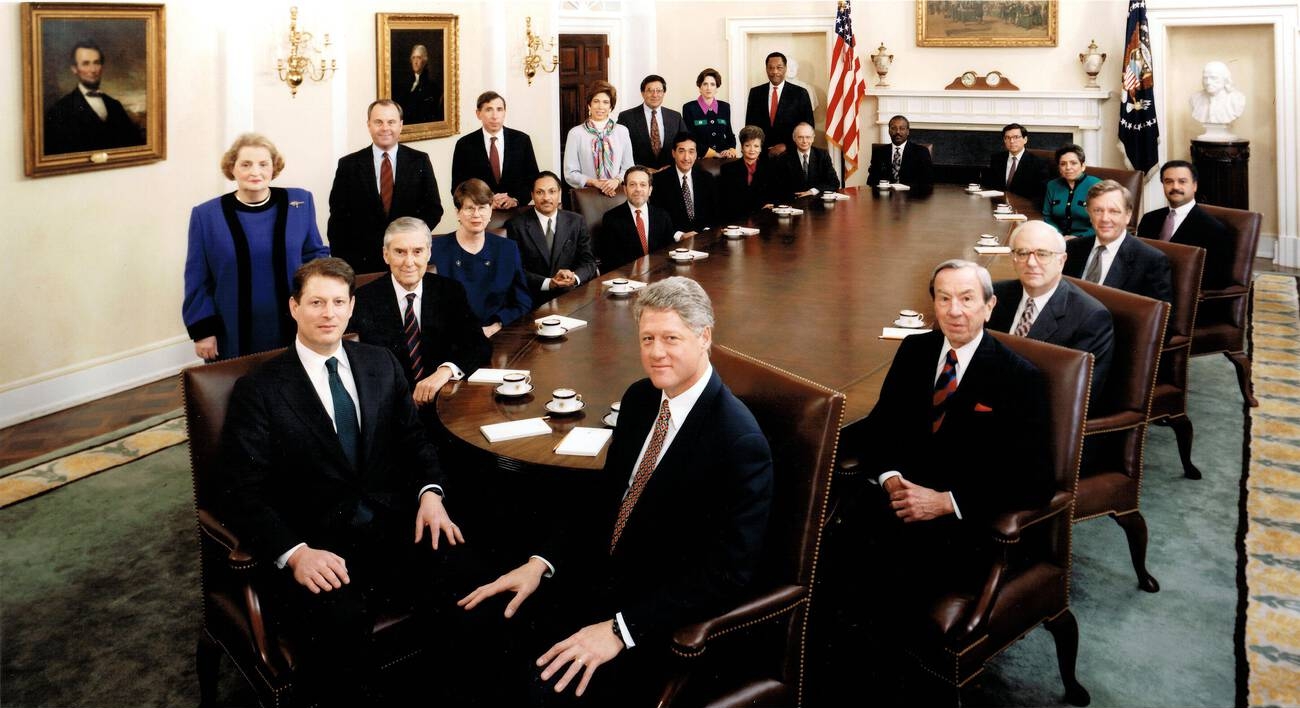
Case Study; The progress of the Clinton Administration 1993-2000

  • Longest economic expansion in American history
    The President’s strategy of fiscal discipline, open foreign markets and investments in the American people helped create the conditions for a record 115 months of economic expansion. Our economy has grown at an average of 4 percent per year since 1993.
  • More than 22 million new jobs
    More than 22 million jobs were created in less than eight years -- the most ever under a single administration, and more than were created in the previous twelve years.
  • Highest homeownership in American history
    A strong economy and fiscal discipline kept interest rates low, making it possible for more families to buy homes. The homeownership rate increased from 64.2 percent in 1992 to 67. 7 percent, the highest rate ever.
  • Lowest unemployment in 30 years
    Unemployment dropped from more than 7 percent in 1993 to just 4.0 percent in November 2000. Unemployment for African Americans and Hispanics fell to the lowest rates on record, and the rate for women is the lowest in more than 40 years.
  • Raised education standards, increased school choice, and doubled education and training investment
    Since 1992, reading and math scores have increased for 4th, 8th, and 12th graders, math SAT scores are at a 30-year high, the number of charter schools has grown from 1 to more than 2,000, forty-nine states have put in place standards in core subjects and federal investment in education and training has doubled.
  • Largest expansion of college opportunity since the GI Bill
    President Clinton and Vice President Gore have nearly doubled financial aid for students by increasing Pell Grants to the largest award ever, expanding Federal Work-Study to allow 1 million students to work their way through college, and by creating new tax credits and scholarships such as Lifetime Learning tax credits and the HOPE scholarship. At the same time, taxpayers have saved $18 billion due to the decline in student loan defaults, increased collections and savings from the direct student loan program.
  • Connected 95 percent of schools to the Internet
    President Clinton and Vice President Gore’s new commitment to education technology, including the E-Rate and a 3,000 percent increase in educational technology funding, increased the percentage of schools connected to the Internet from 35 percent in 1994 to 95 percent in 1999.
  • Lowest crime rate in 26 years
    Because of President Clinton’s comprehensive anti-crime strategy of tough penalties, more police, and smart prevention, as well as common sense gun safety laws, the overall crime rate declined for 8 consecutive years, the longest continuous drop on record, and is at the lowest level since 1973.
  • 100,000 more police for our streets
    As part of the 1994 Crime Bill, President Clinton enacted a new initiative to fund 100,000 community police officers. To date more than 11,000 law enforcement agencies have received COPS funding.
  • Enacted most sweeping gun safety legislation in a generation
    Since the President signed the Brady bill in 1993, more than 600,000 felons, fugitives, and other prohibited persons have been stopped from buying guns. Gun crime has declined 40 percent since 1992.
  • Family and Medical Leave Act for 20 million Americans
    To help parents succeed at work and at home, President Clinton signed the Family and Medical Leave Act in 1993. Over 20 million Americans have taken unpaid leave to care for a newborn child or sick family member.
  • Smallest welfare rolls in 32 years
    The President pledged to end welfare as we know it and signed landmark bipartisan welfare reform legislation in 1996. Since then, caseloads have been cut in half, to the lowest level since 1968, and millions of parents have joined the workforce. People on welfare today are five times more likely to be working than in 1992.
  • Higher incomes at all levels
    After falling by nearly $2,000 between 1988 and 1992, the median family’s income rose by $6,338, after adjusting for inflation, since 1993. African American family income increased even more, rising by nearly $7,000 since 1993. After years of stagnant income growth among average and lower income families, all income brackets experienced double-digit growth since 1993. The bottom 20 percent saw the largest income growth at 16.3 percent.
  • Lowest poverty rate in 20 years
    Since Congress passed President Clinton’s Economic Plan in 1993, the poverty rate declined from 15.1 percent to 11.8 percent last year — the largest six-year drop in poverty in nearly 30 years. There are now 7 million fewer people in poverty than in 1993. The child poverty rate declined more than 25 percent, the poverty rates for single mothers, African Americans and the elderly have dropped to their lowest levels on record, and Hispanic poverty dropped to its lowest level since 1979.
  • Lowest teen birth rate in 60 years
    In his 1995 State of the Union Address, President Clinton challenged Americans to join together in a national campaign against teen pregnancy. The birth rate for teens aged 15-19 declined every year of the Clinton Presidency, from 60.7 per 1,000 teens in 1992 to a record low of 49.6 in 1999.
  • Lowest infant mortality rate in American history
    The Clinton Administration expanded efforts to provide mothers and newborn children with health care. Today, a record high 82 percent of all mothers receive prenatal care. The infant mortality rate has dropped from 8.5 deaths per 1,000 in 1992 to 7.2 deaths per 1,000 in 1998, the lowest rate ever recorded.
  • Deactivated more than 1,700 nuclear warheads from the former Soviet Union
    Efforts of the Clinton-Gore Administration led to the dismantling of more than 1,700 nuclear warheads, 300 launchers and 425 land and submarine based missiles from the former Soviet Union.
  • Protected millions of acres of American land
    President Clinton has protected more land in the lower 48 states than any other president. He has protected 5 new national parks, designated 11 new national monuments and expanded two others and proposed protections for 60 million acres of roadless areas in America’s national forests.
  • Paid off $360 billion of the national debt
    Between 1998-2000, the national debt was reduced by $363 billion — the largest three-year debt pay-down in American history. We are now on track to pay off the entire debt by 2009.
  • Converted the largest budget deficit in American history to the largest surplus
    Thanks in large part to the 1993 Deficit Reduction Act, the 1997 Balanced Budget Act, and President Clinton’s call to save the surplus for debt reduction, Social Security, and Medicare solvency, America has put its fiscal house in order. The deficit was $290 billion in 1993 and expected to grow to $455 billion by this year. Instead, we have a projected surplus of $237 billion.
  • Lowest government spending in three decades
    Under President Clinton federal government spending as a share of the economy has decreased from 22.2 percent in 1992 to a projected 18.5 percent in 2000, the lowest since 1966.
  • Lowest federal income tax burden in 35 years
    President Clinton enacted targeted tax cuts such as the Earned Income Tax Credit expansion, $500 child tax credit, and the HOPE Scholarship and Lifetime Learning Tax Credits. Federal income taxes as a percentage of income for the typical American family have dropped to their lowest level in 35 years.
  • By January 2001, more families owned stock than ever before
    The number of families owning stock in the United States increased by 40 percent since 1992.
  • Most diverse cabinet in American history
    President Clinton appointed more African Americans, women and Hispanics to the Cabinet than any other President in history. He appointed the first female Attorney General, the first female Secretary of State and the first Asian American cabinet secretary ever.

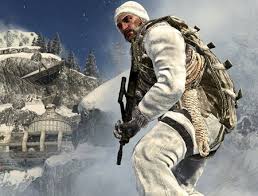
Black Ops set for midnight launch


The eagerly anticipated sequel to the biggest selling video game in history goes on sale tonight.
Thousands of gamers are expected to queue at over 400 stores in the UK to get their hands on a copy of Call of Duty: Black Ops.
The title goes on sale at midnight, with special events being held in cities across the globe.
Its predecessor, Call of Duty: Modern Warfare 2, generated more than $1 billion (£618) in sales.
That puts it in an elite club of billion-dollar entertainment giants such as James Cameron's Titanic and Michael Jackson's Thriller.
Call of Duty: Black Ops is the seventh game in the series and the third to be developed by US based developer Treyarch.
Piers Harding-Rolls, an analyst with Screen Digest, told BBC News that he thought Black Ops would do as well, if not better, that Modern Warfare 2.
"We're looking up to 18 million units sold worldwide, putting it in the same league as Modern Warfare 2," he said.
"This edition also has a [Nintendo] Wii version and while the average Wii owner probably won't be that interested, it does mean that the potential market is a bit bigger than before," he added.
Gamers play as a CIA operative or Special Forces agent; members of a clandestine agency tasked with uncovering a Soviet chemical weapon code named Nova-6 during the Cold War.
In addition to standard ground combat, Treyarch have added a mission in which users control a Russian Hind helicopter, as well as flying US spy planes.
There is also a bonus multi player level where users have to defend Washington from waves of flesh-eating zombies.
Stocking fillers
Call of Duty: Black Ops is the last of the big first-person-shooter titles to be released in the run up Christmas.
Halo Reach - the exclusive XBox 360 title released in September - sold more than 300,000 copies on its launch day, according to the games industry magazine MCV.
Medal of Honor, Call of Duty's traditional rival, has also recently had a refresh.
The latest edition courted controversy by allowing gamers to take on the role of the Taliban, prompting calls from soldiers and politicians for the game to be banned. Its publisher Electronic Arts eventually renamed the enemy forces "the Opposition".
Recent figures suggest that, despite the publicity, Medal of Honour sold less than 350,000 units in the UK. By comparison, Call of Duty: Modern Warfare 2 sold an 1.23 million units, according to industry body Elspa.
"Medal of Honour didn't review particularly well and its still the case that those who don't have an average score [in the games press] in the 80 and 90s don't sell as well," said Mr Harding-Rolls.

Monday, 1 November 2010

Alcohol 'more harmful than heroin'?


Alcohol is more harmful than heroin or crack, according to a study published in medical journal the Lancet.
The report is co-authored by Professor David Nutt, the former UK chief drugs adviser who was sacked by the government in October 2009.
It ranks 20 drugs on 16 measures of harm to users and to wider society.
Gavin Partington, of the Wine and Spirit Trade Association, said alcohol abuse affected "a minority" who needed "education, treatment and enforcement".
The study also said tobacco and cocaine are judged to be equally harmful, while ecstasy and LSD are among the least damaging.
Harm score
Prof Nutt refused to leave the drugs debate when he was sacked from his official post by the former Labour Home Secretary, Alan Johnson.
He went on to form the Independent Scientific Committee on Drugs, a body which aims to investigate the drug issue without any political interference.
One of its other members is Dr Les King, another former government adviser who quit over Prof Nutt's treatment.
Members of the group, joined by two other experts, scored each drug for harms including mental and physical damage, addiction, crime and costs to the economy and communities.
study involved 16 criteria, including a drug's affects on users' physical and mental health, social harms including crime, "family adversities" and environmental damage, economic costs and "international damage".
The modelling exercise concluded that heroin, crack and methylamphetamine, also known as crystal meth, were the most harmful drugs to individuals, but alcohol, heroin and crack cocaine were the most harmful to society.
When the scores for both types of harm were added together, alcohol emerged as the most harmful drug, followed by heroin and crack.
'Valid and necessary'
The findings run contrary to the government's long-established drug classification system, but the paper's authors argue that their system - based on the consensus of experts - provides an accurate assessment of harm for policy makers.
"Our findings lend support to previous work in the UK and the Netherlands, confirming that the present drug classification systems have little relation to the evidence of harm," the paper says.
"They also accord with the conclusions of previous expert reports that aggressively targeting alcohol harms is a valid and necessary public health strategy."
In 2007, Prof Nutt and colleagues undertook a limited attempt to create a harm ranking system, sparking controversy over the criteria and the findings.
The new more complex system ranked alcohol three times more harmful than cocaine or tobacco. Ecstasy was ranked as causing one-eighth the harm of alcohol.
It also contradicted the Home Office's decision to make so-called legal high mephedrone a Class B drug, saying that alcohol was five times more harmful. The rankings have been published to coincide with a conference on drugs policy, organised by Prof Nutt's committee.
'Extraordinary lengths'
Prof Nutt told the BBC: "Overall, alcohol is the most harmful drug because it's so widely used.
"Crack cocaine is more addictive than alcohol but because alcohol is so widely used there are hundreds of thousands of people who crave alcohol every day, and those people will go to extraordinary lengths to get it."
He said it was important to separate harm to individuals and harm to society.
The Lancet paper written by Prof Nutt, Dr King and Dr Lawrence Phillips, does not examine the harm caused to users by taking more than one drug at a time.
Mr Partington, who is the spokesman for the Wine and Spirit Trade Association, said millions of people enjoyed alcohol "as part of a regular and enjoyable social drink".
"Clearly alcohol misuse is a problem in the country and our real fear is that, by talking in such extreme terms, Professor Nutt and his colleagues risk switching people off from considering the real issues and the real action that is needed to tackle alcohol misuse," he said.
"We are talking about a minority. We need to focus policy around that minority, which is to do with education, treatment and enforcement."
A Home Office spokesman said: "Our priorities are clear - we want to reduce drug use, crack down on drug-related crime and disorder and help addicts come off drugs for good."

Wednesday, 6 October 2010

Chilean Miners to be finally rescued?

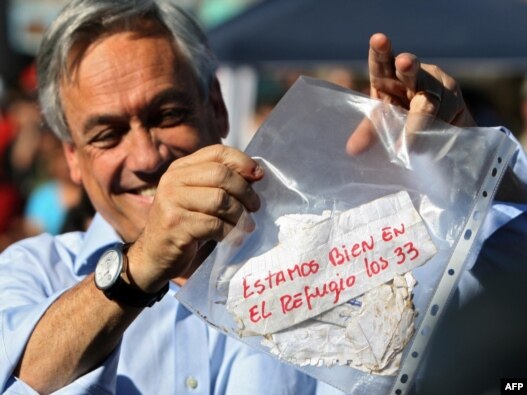
The first of Chile’s 33 trapped miners may be free by Oct. 10, more than two months after a mine accident stranded the workers, an official aiding the rescue efforts said. The second of three rescue shafts being drilled has reached a depth of 520 meters (1,700 feet) after a drill bit was changed last night, said Eugenio Eguiguren, international vice president of Geotec Boyles Bros, which is drilling the hole.

The drill has another 102 meters to go before reaching the miners, who have been trapped since an Aug. 5 cave-in at the mine in northern Chile, he said.

Once the drilling rig breaks through 622 meters, which could happen as soon as Oct. 8, rescuers will send down a video camera to determine if the shaft is stable enough to pull out the workers without first casing the walls, Eguiguren said. Installing a casing would take three or four days, he said.

“The deeper it gets, the more complicated things become,” Eguiguren said today in a telephone interview from the company’s Santiago office. “Everything is going well. I think they’ll be getting out this Sunday or Monday.”

Chilean President Sebastian Pinera said Oct. 4 the miners could be rescued before he starts a trip to Europe on Oct. 15. To contact the reporter on this story: Nathan Crooks in Santiago at ncrooks@bloomberg.net

To contact the editor responsible for this story: Dale Crofts at dcrofts@bloomberg.net.

Source; http://www.bloomberg.com/news/2010-10-06/trapped-chile-miners-may-be-free-by-weekend-after-two-month-rescue-effort.html

Saturday, 25 September 2010

Chelsea's unbeaten run comes to an abrupt end

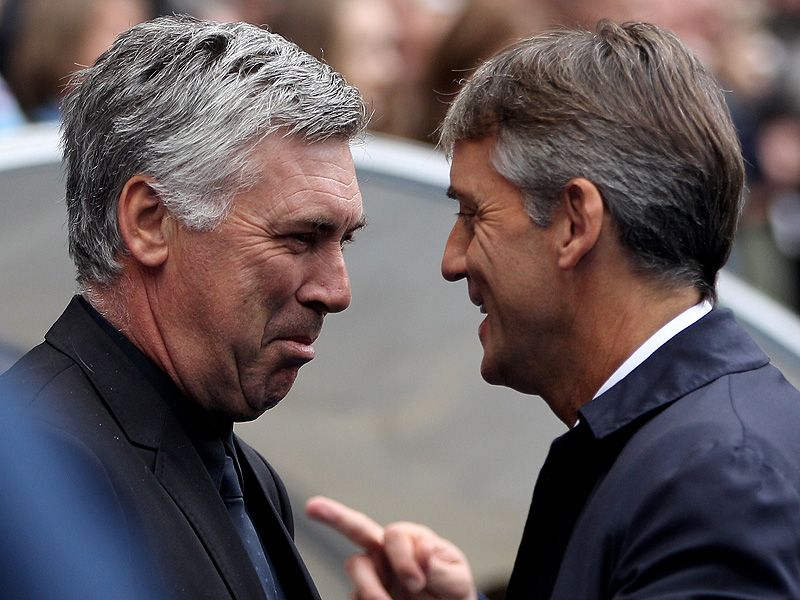
Manchester City ended Chelsea's unbeaten start to the Premier League season as Carlos Tevez netted the solitary strike in a 1-0 win at the City of Manchester Stadium.  The first half was notable only for a Branislav Ivanovic header which struck the crossbar, but a piece of magic from the City captain lit up the second. The Argentine hurtled through the Chelsea half on the hour mark before applying a clinical finish to beat Petr Cech, and Carlo Ancelotti's side could not muster a response.

Roberto Mancini had surprisingly reported prior to the game that the title was Chelsea's, but the Italian was left to enjoy the bottle of red he promised his counterpart if the hosts won as his side inflicted the champions' first defeat of the season.

City made just one change from the team which beat Wigan as Dedryck Boyata came in for the injured Micah Richards, while Chelsea skipper John Terry returned as Paulo Ferreira missed out and Nicolas Anelka replaced Salomon Kalou.

It was a cagey yet frenetic opening as the two richest clubs in the league hustled and harried in a heavily congested midfield with neither side afforded the luxury of being able to enjoy a period of sustained possession.

There were no clear-cut openings mustered, before Ivanovic struck the crossbar with a looping header on the half hour as a relieved Joe Hart watched on helplessly as the hosts were eventually able to alleviate the danger.

Four minutes later, Pablo Zabaleta hauled down the marauding Ivanovic on the edge of the City box, but Didier Drogba lashed the resulting free-kick over the bar as Hart looked on disdainfully.

The last time Chelsea went in at the break with the game goalless was on Boxing Day against Birmingham, but for both sides a circumspect approach was paramount.

Neither manager deemed it necessary to make any changes at the break and, within seconds of the restart, Anelka fired a rasping effort towards the far post which Hart did well to tip away for a corner.

The game was crying out for a moment of decisive brilliance, and it was Tevez who provided it on the hour mark.

The Argentine had scored five goals in his last four Premier League appearances against Chelsea, and he was on target against the champions yet again after he used Silva as a decoy runner before driving a low shot through Cole's legs and beyond Cech into the far corner of the net.

Ancelotti reacted swiftly to his side conceding only their second goal of the league campaign, and surprisingly a frustrated Drogba was one of two changes to immediately follow the goal.

The 19-year-old Boyata was a powerful defensive presence for City all afternoon, but he almost cost his side after he hauled down substitute Yuri Zhirkov with a rash challenge on the edge of his box.

Florent Malouda whipped over a devilish delivery from the resulting set piece, and Alex rose imperiously before heading wide as a glorious opportunity to equalise was squandered 10 minutes from time. It was a frustrated Chelsea side which ended the match, and City preserved their slender lead with a stout defensive display late on.

As a result of the win, City move to within four points of Chelsea, who remain top despite suffering their first defeat of the season. Arsenal and Manchester United can subsequently move to within a point of the champions with victories this weekend.


Source; http://uk.eurosport.yahoo.com/25092010/58/premier-league-manchester-city-stun-chelsea.html

Tuesday, 21 September 2010

Geo-engineering to reduce GW?

Reflecting sunlight from the Earth by geoengineering would undoubtedly cool the climate, but would different countries agree on how much to reflect? Research by climate scientists at the University of Bristol shows that the impact of geoengineering would be felt in very different ways across the world.

Previous studies of geoengineering approaches, aimed at averting dangerous climate change, have shown that although the average global temperature could be restored to 'normal' levels, some regions would remain too warm, whereas others would 'overshoot' and cool to much. In addition, average rainfall would be reduced.

This new study looked at the impacts of different strengths of geoengineering, from full strength (sufficient to return global average temperatures back to normal), through to no geoengineering.

Reporting in Geophysical Research Letters, the researchers looked at how the impacts caused by these different strengths of geoengineering differed from region to region, using a comprehensive climate model developed by the UK Met Office, which replicates all the important aspects of the climate system, including the atmospheric, ocean and land processes, and their interactions.

Their analysis revealed that with increasing geoengineering strength, most regions become drier while others buck the trend and become increasingly wet. For example, the USA became drier with increasing geoengineering, and returned to normal conditions under half-strength geoengineering, whereas Australia became wetter, returning to normal conditions only for full strength geoengineering.

Pete Irvine, lead author on the paper, points out there are likely to be disagreements over any future geoengineering schemes: "If there is a large amount of global warming in the future there would be no strength of geoengineering that would be best for everyone: some may be better off without any geoengineering while others may do better with a large amount." The team suggest that global average figures are too simple a measure to assess the impacts of geoengineering, and that decision makers of the future need to consider a variety of impacts, such as on regional precipitation, sea-level response, global crop yield before deciding whether embarking on geoengineering would be the right choice.

However, the work does offer some way forward. Co-author Dan Lunt added: "Our simulations indicate that it might be possible to identify a strength of geoengineering capable of meeting multiple targets, such as maintaining a stable mass balance of the Greenland ice sheet and cooling global climate, but without reducing global precipitation below normal amounts or exposing significant fractions of the Earth to unusual climate conditions."

Source; http://noliesradio.org/archives/15053

Sunday, 19 September 2010

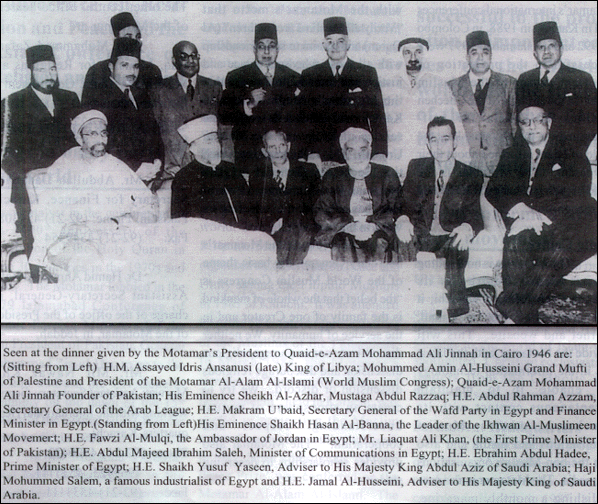
The 'World Muslim Congress' making

The World Muslim Congress (Motamar Al-Alam Al-Islami) was founded in an assemblage of eminent leaders from the World of Islam held in Makkah in 1926. King Abdul Aziz of Saudi Arabia played host to the Congress. The Congress resolved that a permanent international Islamic organization be set up to promote solidarity and cooperation among the global Islamic community (Ummah).

It assumed organizational shape in the second International Islamic Conference held in Baitul Maqdas (Jerusalem) in 1931.The constitution and rules and regulations of the Motamar Al-Islam Al-Islami) were framed and approved in this conference.

After the birth of the Muslim-majority State of Pakistan on August 14, 1947, eminent Signatories of the World of Islam began working for the revival of the Motamar Al-Alam Al-Islam. Its revival was achieved in a World Muslim Conference held in Karachi, the capital of Pakistan at that time in February 1949.
 
In 1950, the Motamar submitted a scroll bearing a million signatures supporting the Kashmiris' right of self-determination and a UN-supervised plebiscite to the first secretary-general of the United Nations, Mr. Trygve Lie in New York.
 
This was followed by a bigger conference of the Motamar held in Karachi in February 1951. This Conference gave a new form and shape to the Motamar Al-Alam Al-Islami, making Karachi the headquarters of the Motamar, with Alhaj Aminul Hussaini, the Grand Mufti of Palestine, as its President and Dr. Insamullah Khan as its secretary-general.The Motamar's 1951 Conference held in Karachi saw the seeding of many ideas of cooperation amongthe Muslim countries and people, which in the years that followed became realities.


Source; http://www.motamaralalamalislami.org/

Saturday, 11 September 2010

The international "Burn a Qur'an day" event cancelled permanently

At the Pentagon, President Barack Obama said the US was not at war with Islam.

Earlier, the pastor behind the threat to burn Korans in Florida said the event has been cancelled permanently.

"We will definitely not burn the Koran, no," the Reverend Terry Jones told NBC's Today show.  "Not today, not ever," he said when pressed about whether his planned demonstration might happen at a later date.

Speaking at a memorial event at the Pentagon - which was also hit by an airliner on 11 September 2001 - President Obama paid tribute to those who died in the attacks, saying America's greatest weapon was to stay true to itself.

"It was not a religion that attacked us that September day. It was Al-Qaeda," he said. "We will not sacrifice the liberties we cherish or hunker down behind walls of suspicion and mistrust," he said.

Saturday saw new protests in mainly Muslim countries over the Koran-burning proposal, with rallies reported in Somalia and Afghanistan. Pastor Terry Jones had said he hoped to meet a leading imam to discuss the proposal for the Islamic centre, to be located a short distance from Ground Zero, the WTC site.
He said he had suspended the book-burning only because he had received a guarantee, from an imam in Florida, that the centre would be moved. But the planners of the Islamic centre have said they did not speak to the Florida imam, and would not be moving their project.

Mr Abdul Rauf said on Friday that he was "prepared to consider meeting with anyone who is seriously committed to pursuing peace" but added that he had no current plans to meet Mr Jones. Mr Jones is the pastor of the tiny and previously little-known Dove World Outreach Center in Gainesville, Florida, and author of a book entitled Islam is of the Devil. He had planned to stage an International Burn a Koran Day on Saturday, saying the book was "evil". But pressure was put on the pastor to cancel the burning. The FBI visited Mr Jones to urge him to reconsider his plans and he was telephoned by US Defence Secretary Robert Gates.

In his remarks on Friday, Mr Obama denied that his administration's intervention in the affair had elevated it to greater prominence. He appealed to Americans to respect the "inalienable" right of religious freedom and said he hoped the preacher would abandon his plan to burn the Koran, as it could add to the dangers facing US soldiers serving abroad. "This is a way of endangering our troops, our sons and daughters... you don't play games with that," he told reporters.


Source; http://www.bbc.co.uk/news/world-us-canada-11269681

Monday, 6 September 2010

The merits and etiquette of the last ten days of Ramadan


By Shaykh Ali Al Timimi

(May Allah SWT have mercy on Him and ease His suffering, Ameen)
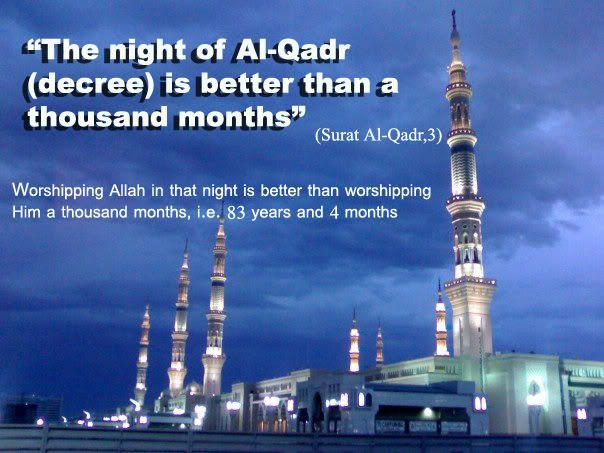
My dear brothers and sisters! It is reported in as-Sahihayn that ‘A’isha – may Allah be pleased with her – informs that when the last ten nights began Allah’s Messenger (sallallahu ‘alaihi wa sallam) would ‘tighten his izar’, keep awake during the night, and awaken his family. In Muslim’s report she said that Allah’s Messenger (sallallahu ‘alaihi wa sallam) would exert himself during the last nights to a greater extent than at any other time.

The Prophet (sallallahu ‘alaihi wa sallam) would emphasize the last ten nights of Ramadan what he would not emphasize at any other time during the month by performing specific acts that he would not perform at any other time during the month. The scholars who have studied the Prophet’s Sunnah (sallallahu ‘alaihi wa sallam) have identified six specific acts that he would do unlike the other nights of Ramadan:

He would keep awake during the night

This could imply that he would keep awake throughout the whole night. For it is reported in al-Musnad upon ‘A’isha that the Prophet (sallallahu ‘alaihi wa sallam) would combine the [first] twenty nights [of Ramadan] with prayer and sleep, but if the [final] ten nights began he would ‘pull up and tighten his izar. Or this could imply that he would keep awake most of the night. Some of the earliest scholars have stated whoever keeps awake half the night, has kept awake all the night.

He would awaken his family for prayer

Abu Dharr – may Allah be pleased with her – that Prophet (sallallahu ‘alaihi wa sallam) led them in [night] prayer during the night of the twenty-third, the twenty-fifth, and the twenty-seventh. It is mentioned that he called his family and his women [to pray] during the night of the twenty-seventh in particular. This shows that it is stressed to awaken them during the more emphasized odd nights which laylatul-qadr is sought. Sufyan ath-Thawri would say, “It is so beloved to me if the last ten nights begin for someone to pray tahajjud and exert oneself and awaken one’s wife and children to pray if they can endure that.”

He would tighten his izar

This Arabic expression means he would stay away from his wives. It is reported that he would not return to his bed until Ramadan ended. Anas reports he would roll up his bed and stay away from his wives. The Prophet (sallallahu ‘alaihi wa sallam) would perform ‘itikaf during the last ten nights. It is forbidden for the one performing ‘itikaf to have sexual relations. The wisdom behind this is that while Allah permitted during the month of Ramadan sexual relations during the night, it was legislated that during the last ten nights for those seeking layatul-qadr to avoid sexual relations so that they might not miss it. For this reason those engaged in ‘itikaf are prohibited from sexual relations.

He would delay his breaking of his fast until his predawn meal

It is reported upon ‘A’isha and Anas that he the Prophet (sallallahu ‘alaihi wa sallam) would delay his dinner until sahur. This is because dhikr for those who know Allah suffices them from food and drink.

He would wash himself between maghrib and ‘isha

Ibn Abi ‘Asim reports that ‘A’isha has reported this. Ibn Jarir says the earliest Muslims used to like to wash every night of the last ten. Some of them would wash and perfume themselves. Hammad ibn Salama said that Thabit and Humaid would wear their best clothes and perfume themselves and perfume the mosque during those nights which one would expect laylatul-qadr. So it is preferable during these last ten nights, and especially those which one expects laylatul-qadr, to beautify oneself by cleaning oneself, wearing perfume and one’s best clothes. One does not truly beautify oneself outwardly unless one beautifies oneself inwardly by repentance and remorse. For outer beauty with inner ugliness is worthless.

He would perform ‘itikaf

‘A’isha said that the Prophet (sallallahu ‘alaihi wa sallam) used to engage in ‘itikaf during the last ten nights of Ramadan till Allah took him, and then his wives followed this practice after his death. This reported by al-Bukhari and Muslim. Seclusion for worship is legislated in the masajid so that neither the congregational nor the jumu’a prayers are missed. To seek seclusion elsewhere is a reprehensible innovation. My brothers and sisters! We have been commanded to seek to perform as many good deeds, be they obligatory or just praiseworthy. At the same time, we are ordered to avoid as many evil or reprehensible deeds. Those whom Allah has decreed eternal happiness in the Hereafter will find performance of good deeds and avoidance of evil deeds easy for them, while those whom Allah has decreed eternal sorrow in the Hereafter will find themselves unable to accomplish any good deeds nor avoid any evil deeds. With that we should always remember that what we ultimately seek is that our deeds are accepted, not just mere physical exertion of our bodies. For as the earliest Muslims would say, “How many of those who are awake in prayer are denied Allah’s mercy (mahrum), while those who are asleep are shown it (marhum)?”


Source; http://soul-scripture.blogspot.com/2006/10/ramadhan-1427-merits-and-etiquette-of.html

Thursday, 2 September 2010

A tangible outcome from Middle Eastern 'peace' talks?

Israeli and Palestinian leaders have held their first direct negotiations in nearly two years, in Washington.

The US Middle East envoy said the talks, between Israeli PM Benjamin Netanyahu and Palestinian leader Mahmoud Abbas had been "constructive".
Both sides have agreed to meet again in the Middle East in two weeks. As the talks opened, US Secretary of State Hillary Clinton told Mr Abbas and Mr Netanyahu they had the "opportunity to end this conflict."

Mr Netanyahu said painful concessions from both sides would be needed. Mr Abbas called on Israel to end all settlement construction and lift the blockade of the Gaza Strip. The talks at the US state department, the first such negotiations in 20 months, began with a pledge of "full and active support" from the US.

They had been initiated by US President Barack Obama, who gave them a one-year deadline. He has said the goal is a permanent settlement that ends the Israeli occupation of territory captured in 1967, and an independent, democratic Palestinian state existing peacefully beside Israel.

'Hurdles'

Opening the negotiations, Mrs Clinton said the US had "pledged its full support to these talks and we will be an active and sustained partner", but said Washington would not impose a solution.

"Mr Prime Minister, Mr President, you have the opportunity to end this conflict and the decades of enmity between your peoples once and for all," she said.

"The core issues at the centre of these negotiations - territory, security, Jerusalem, refugees, settlements and others - will get no easier if we wait, nor will they resolve themselves."

Speaking after Mrs Clinton, both Mr Netanyahu and Mr Abbas acknowledged the difficulty of the task ahead."This will not be easy," Mr Netanyahu said. "True peace, a lasting peace, will be achieved only with mutual and painful concessions from both sides."

Mr Abbas said: "We do know how hard are the hurdles and obstacles we face during these negotiations - negotiations that within a year should result in an agreement that will bring peace." The leaders also raised two of the issues that are central to the talks: security for the Israelis, and Jewish settlement construction on Palestinian territories.

"We call on the Israeli government to move forward with its commitment to end all settlement activities and completely lift the embargo over the Gaza Strip," Mr Abbas said.

Mr Netanyahu said "a genuine peace must take into account the security needs of Israel". He also repeated the demand that the Palestinians recognise Israel as a Jewish state. After their statements, Mrs Clinton, Mr Abbas, Mr Netanyahu and the US envoy to the Middle East talks, George Mitchell, broke off for talks away from the media.

Mr Mitchell emerged to say that Mr Abbas and Mr Netanyahu were talking alone. He said relations between the two men were "cordial" and there was a "constructive and positive mood". He said the two leaders had agreed to hold further talks in the Middle East on 14-15 September, then about every two weeks after that.

It had already been agreed, Mr Mitchell said, that the two sides would work to reach a framework agreement on all the issues dividing them that would pave the way for a comprehensive treaty.

Source; http://www.bbc.co.uk/news/world-us-canada-11162585

Thursday, 19 August 2010

Great quotes in World history

.

“Do not spoil what you have by desiring what you have not; remember that what you now have was once among the things you only hoped for.”

Epicurus quotes (Greek philosopher, BC 341-270)


"Contentment is natural wealth, luxury is artificial poverty”

Socrates quotes (Ancient Greek Philosopher, 470 BC-399 BC)


"I dream of giving birth to a child who will ask, "Mother, what was war?"

Eve Merriam (American poet, 1916-1992)


“A leader is one who knows the way, goes the way, and shows the way.”

John C. Maxwell (International speaker)


“If my mind can conceive it, and my heart can believe it, I know I can achieve it.”

Jesse Jackson (Civil rights activist)


"Falsehood has an infinity of combinations, but truth has only one mode of being.”

Jean-Jacques Rousseau (French philosopher, 1712-1778)

.

Tuesday, 17 August 2010

Malcolm X defending justice of the innocent


Malcolm X appears on a television show in Chicago called "City Desk" on March 17, 1963.